Executive Summary
Kinetiq is the largest liquid staking protocol on Hyperliquid, solving HyperEVM's throughput bottleneck for DeFi activity by building Elysium, Hyperliquid's first layer 2, which launched on November 9. We believe KNTQ, Kinetiq's native token, is undervalued on liquid staking multiples as it rerates into the single value-capture asset for both L2 sequencer fees and liquid staking revenue.
Key Takeaways
- Kinetiq has built two products: kHYPE, Hyperliquid's largest LST, and Elysium, Hyperliquid's first L2. kHYPE holds ~23% of Hyperliquid L1's TVL, about $766M, with 77% of its liquid staking market, and Kinetiq has earned $3.30M of revenue in the trailing 12 months.
- KNTQ is an asymmetric bet on Hyperliquid adoption that wins from both ends. It moves 1.37x HYPE's daily returns as HYPE has gained 150% against BTC. Staking grows as conviction in HYPE grows, while Elysium pays gas in HYPE and sends 50% of its sequencer revenue to buy KNTQ on the open market, with no separate Elysium token. At our $0.35 entry, KNTQ's market cap is 34x its trailing 12-month revenue, near the 10.5x median for liquid staking tokens and far below the 176x median for L2 tokens.
- We believe the market overweights the token unlocks starting November 27, which vest 12.92M KNTQ a month for the next 24 months. Elysium's launch could create a pump for investors to exit into, though we expect its partner launches to carry demand beyond the cliff. Even if half of every unlock is sold, selling averages $3.65M a month, and buyers from KNTQ's Jan-Oct 2026 trading cover 92% of it. We expect sequencer buybacks and a growing buyer base to close that gap.
- Hyperliquid's dual-block design suits perps but congests HyperEVM for DeFi, where swaps have cost as much as $20. Elysium launched with 100-millisecond blocks, a token pipeline to HyperCore listings, and Uniswap, Pump.fun, fomo and Derive on board. Their activity drives the sequencer fees we value; additionally, certain partners have pledged 40% of their revenue to KNTQ buybacks.
- We hold KNTQ to a $1.00 target by December 2027, 186% above our $0.35 entry, which assumes about $750K a month of KNTQ buybacks: Blast-level sequencer fees from Elysium plus our estimate of partner buying. We value those buybacks at 54.6x holder revenue and grow buyers an average 4% a month. Our base case puts KNTQ at $0.66; our bear case, at the comparable median, $0.25.
Every case above runs live in the model: move Elysium’s buybacks, partner buying, sell-through or HYPE and the values recalculate.
 $KNTQ
Project Overview
Kinetiq: Becoming Hyperliquid's Economic Engine
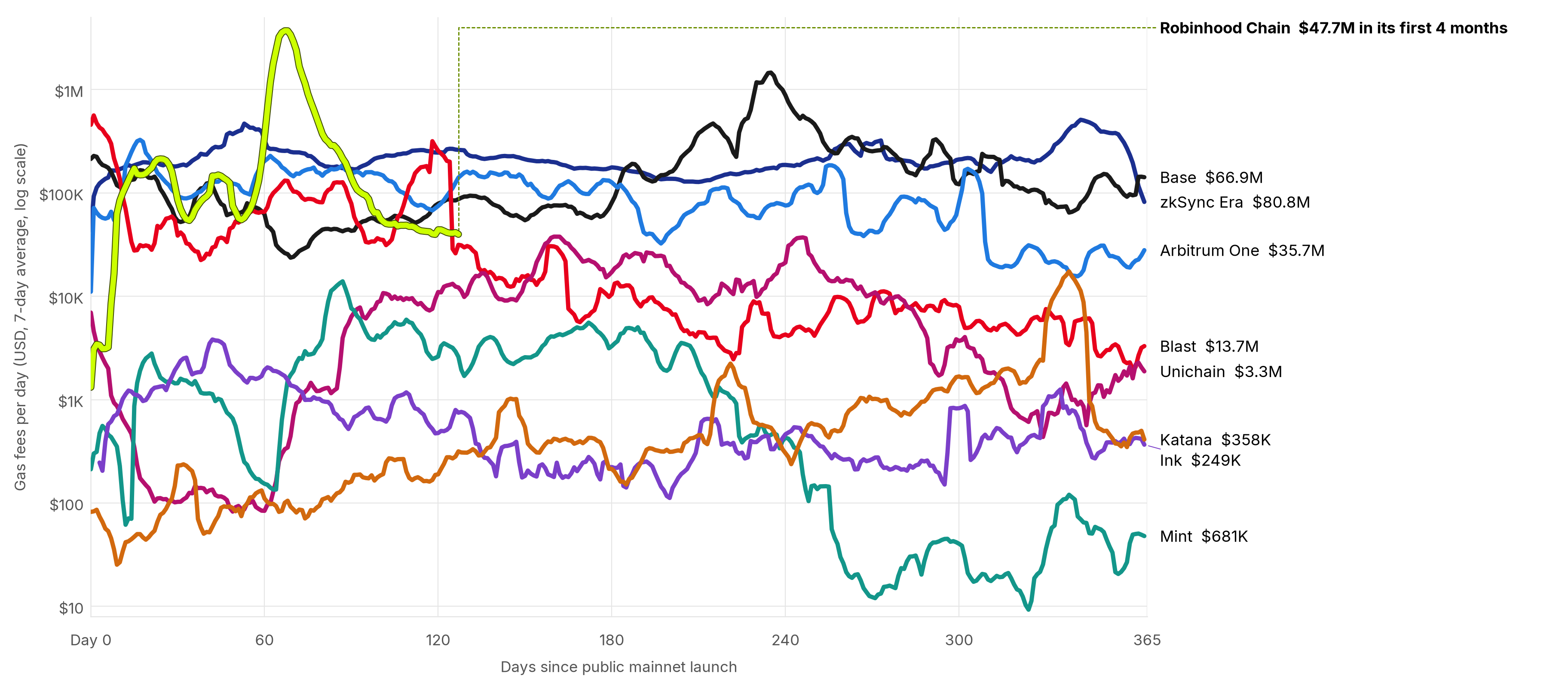
At first glance, Kinetiq's fundamentals are lackluster. kHYPE's $766M in TVL is small next to Lido's $18.7B. Even with over 80% of Hyperliquid's liquid staking market, only $910K of Kinetiq's $3.3M in protocol revenue reached KNTQ holders. But Elysium is where Kinetiq's growth potential lives. Elysium is built as an Arbitrum Orbit chain that settles on HyperEVM and uses HYPE as gas. KNTQ stays the single value-capture asset, so if Elysium draws real activity, Kinetiq no longer depends mainly on staking revenue for its buybacks. Robinhood Chain and Base launched on large customer bases, though few of those customers use DeFi; Robinhood Chain still earned $47.7M in fees in its first four months. Elysium launches with fomo and Pump.fun, opening it to over 3 million lifetime users. That audience is smaller, so we treat Robinhood Chain and Base as the ceiling: at their fee levels, KNTQ buybacks would grow more than 10x within 12 months, a $27M to $57M annual bid against a $112M market cap token.
Kinetiq Infrastructure: kHYPE & Elysium
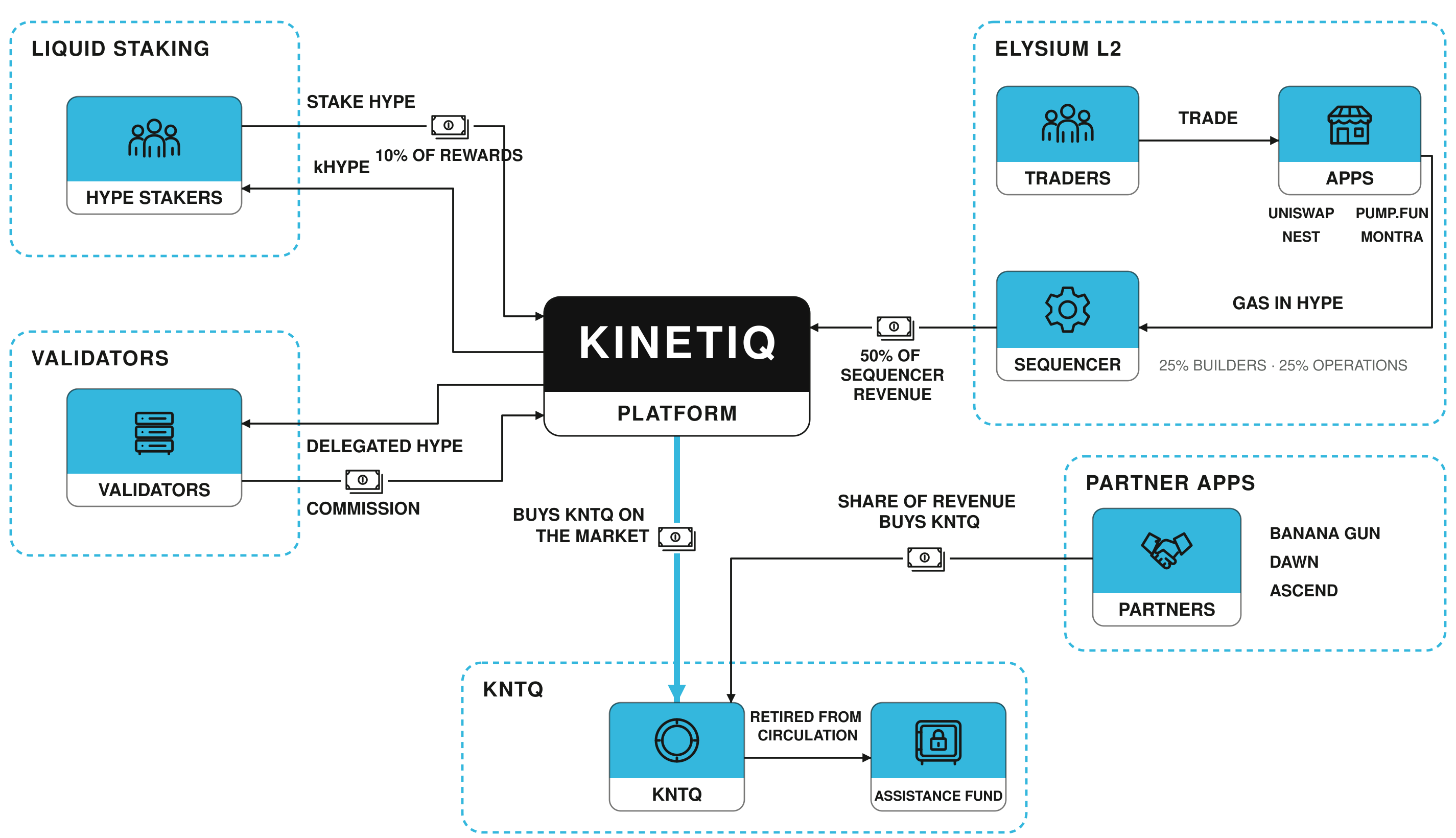
On HyperEVM, users stake HYPE for kHYPE and Kinetiq delegates it across scored validators, keeping 10% of staking rewards and spending 70% of that on KNTQ buybacks and burns, about $106K a month including other products. Elysium runs a single sequencer, whitelisted validators and an AnyTrust data availability committee. It also features a token pipeline: tokens launch on a long-tail Elysium AMM, move to PropAMMs, graduate to a HyperCore spot order book and then get a HIP-3 perp, from the trenches to perps, all paying gas in HYPE. Sequencer revenue splits 25% to builders, 25% to the Kinetiq treasury and 50% to open-market KNTQ buybacks (Figure 2).
Why Hyperliquid Needs Elysium
Hyperliquid utilizes a dual-block architecture, which is advantageous for perps as it keeps HyperEVM contracts in step with HyperCore. However, it causes congestion on HyperEVM, where fast blocks are limited to 3 million gas a second and simple swaps have cost as much as $20. Ethereum had the same issue, and it sparked the growth of Ethereum L2s. However, on Hyperliquid, DeFi TVL fell 63%, from $2.35 billion in August 2025 to $869 million today. Elysium's goal is to bring that DeFi activity back, in what supporters call “a unionization effort” by builders who believe in Hyperliquid's general-purpose vision.
Kinetiq's Position: Base Chain and L2
On the base chain, Kinetiq holds 77% of liquid staking, a market with room to grow: in April, 23.16 million HYPE sat in liquid staking tokens against 405.78 million staked directly. On the L2 side, fees fade once incentives end. For example, zkSync Era earned $80.8 million in fees in its first 365 days, much of it from users farming its airdrop, versus $368,623 in the last 12 months. Elysium's answer is distribution, supporting consumer apps from day one, with fomo as its exclusive trading partner, Pump.fun live from launch, and support from 0x, KyberSwap, Nest Exchange, Derive and Uniswap.
What Elysium Adds
Elysium runs the same EVM apps as any Arbitrum chain, but its advantage lies in its direct line to HyperCore's oracle prices, which lets market makers quote tighter prices on Hyperliquid trades. With 100-millisecond blocks and cheap gas, PropAMMs, pools run by professional market makers, can reprice off Hyperliquid's oracle several times a second, narrowing spreads in a way HyperEVM's 3 million gas a second cannot support. On Solana, PropAMMs carry over 60% of SOL-USDC volume, because cheap, constant updates let makers quote tight spreads without getting picked off. Elysium is tuned so refreshing quotes five to ten times a second stays cheap, and about a month after launch, an ArbOS upgrade lets makers read HyperCore's live order books and hedge onto them in one call. No Ethereum L2 or Solana app can do that without a bridge, which is how Elysium can tighten spreads on Hyperliquid spot, where its share against Binance recently hit a 15-month low.
Elysium's Distribution
Elysium starts with a smaller audience than Base or Robinhood Chain, but few of those chains' parent customers ever trade onchain, while Elysium's partners bring users who already do. Robinhood Chain averaged about 275,000 daily active accounts in late July, under 1% of Robinhood's 28.7 million funded customers, and Base averaged 458,000 daily active addresses in March, against Coinbase's 8.2 million monthly transacting users. Hyperliquid's active perp traders hit a record 263,666 on August 6, close to Robinhood Chain's daily count, and every one already holds assets onchain. Elysium reaches them through its Hyperliquid connection and its partners: fomo, with over 625,000 users, and Pump.fun, which opened Elysium trading in its app on launch day. Partners also buy KNTQ directly: Ascend, a launchpad that uses KNTQ as its token, spends 72% of its fees on KNTQ, and Banana Gun and Oku pledged 40% of their net trading fees to KNTQ buybacks and burns.
Leveraged Exposure to Hyperliquid
KNTQ is a leveraged position on Hyperliquid itself: it moves 1.37x HYPE's daily returns, and over the year to November 8, 2026, HYPE gained 78% in dollars and 150% against BTC. Both of Kinetiq's businesses grow with that trend, funding more KNTQ buybacks.
What KNTQ is Worth
Mature L2 tokens trade at high multiples of chain revenue, with ARB at 157x and OP at 299x while giving nothing back to token holders. However, their multiples price ecosystems built over four to five years, so we measured comparable L2s on their first-year sequencer fees and our staking token multiple.
For our multiple, we value KNTQ on market cap to holder revenue, with Lido and ether.fi as comparables, since both run a staking business and return its revenue to holders through buybacks. Lido is a pure liquid staking token and trades at 37.9 times holder revenue, while ether.fi earns 62.5% of its revenue from its Cash card and the rest mostly from staking, so it trades closer to a neobank at 71.2 times. Kinetiq sits between the two, adding Elysium on top of staking as ether.fi added its card, so we value KNTQ at their 54.6 times median (Figure 4). At Lido's multiple alone, our target falls to $0.70, still 99% above entry.
Figure 4 runs live in the model below.
We read the speculative demand around Elysium's launch as positive sentiment toward its price and onchain activity: implied net buying reached $133.4M in September and $98.6M in October. In our base case, we expect demand for KNTQ to grow an average 4% a month, near the 4.6% median growth in KNTQ's HYPE-adjusted value across six 2026 windows. The model below sets out our valuation.
Risks: Unlocks, Timing, Partners and Fee Decay
Unlocks are the largest risk: the cliff starts November 27, 18 days after Elysium's launch, and the October kPoints paid claim already released 33.71 million KNTQ from the growth vault with no lockup. The timing invites a fair reading that the launch is a strategically timed pump for insiders to exit into, and if activity fades once they sell, sequencer fees decay with it. Against that, insider tokens unlock at 12.92 million KNTQ a month for two years, so a launch rally only helps them sell the first month's share, and the HyperCore integration that makes Elysium useful lands after the cliff.
Partners carry day one; if fomo and Pump.fun flow does not stay, the 25% builder share is Elysium's only retention tool. Fees can decay: Robinhood Chain's DEX volume fell from $54 billion in September to $25.7 billion in October. And because KNTQ moves 1.37 times HYPE's daily returns, a HYPE drawdown would hit KNTQ harder regardless of how Elysium performs.
What to Watch in the Next 90 Days
Elysium launched November 9, unlocks start November 27 and the HyperCore upgrade follows about four weeks later. We will watch sequencer revenue and the first post-launch buyback through the December and January tranches, and track outputs against our model.
Investment Proposal
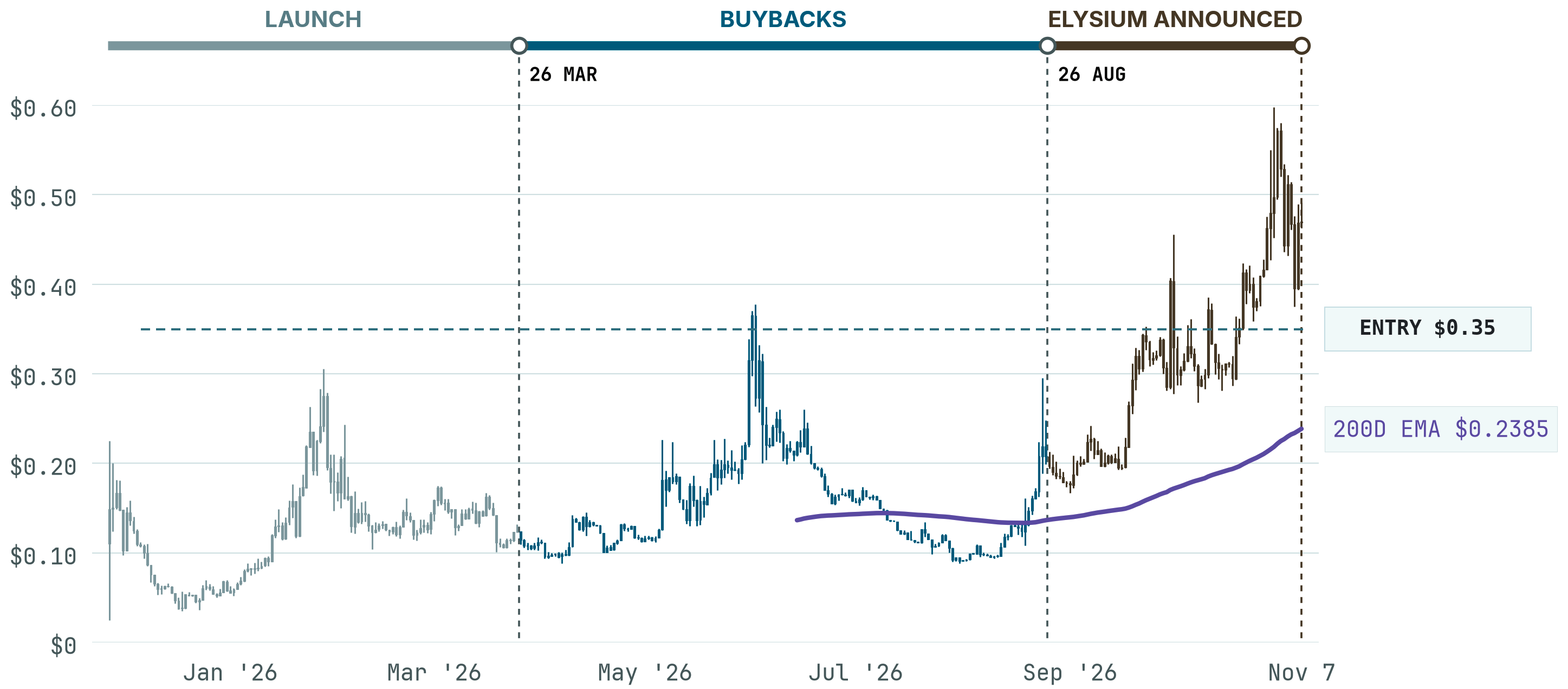
We recommend a long position in KNTQ entered at $0.35, the November 9, 2026 low, and held to December 31, 2027 or our price target of $1.00, 186% above entry.
Hyperliquid already runs most of crypto's onchain perp trading, and HIP-3 is taking it past crypto: on October 29, ICE, the parent of the New York Stock Exchange, agreed to bring Hyperliquid perps on equities, indices and commodities to US traders through trade.xyz, pending regulatory approval. Those traders will want to do more with their assets than HyperEVM can host, and Elysium is built to carry that activity while routing tokens back to HyperCore. KNTQ already moves 1.37 times HYPE, so it offers leveraged exposure to Hyperliquid's growth, with Elysium's sequencer revenue on top.
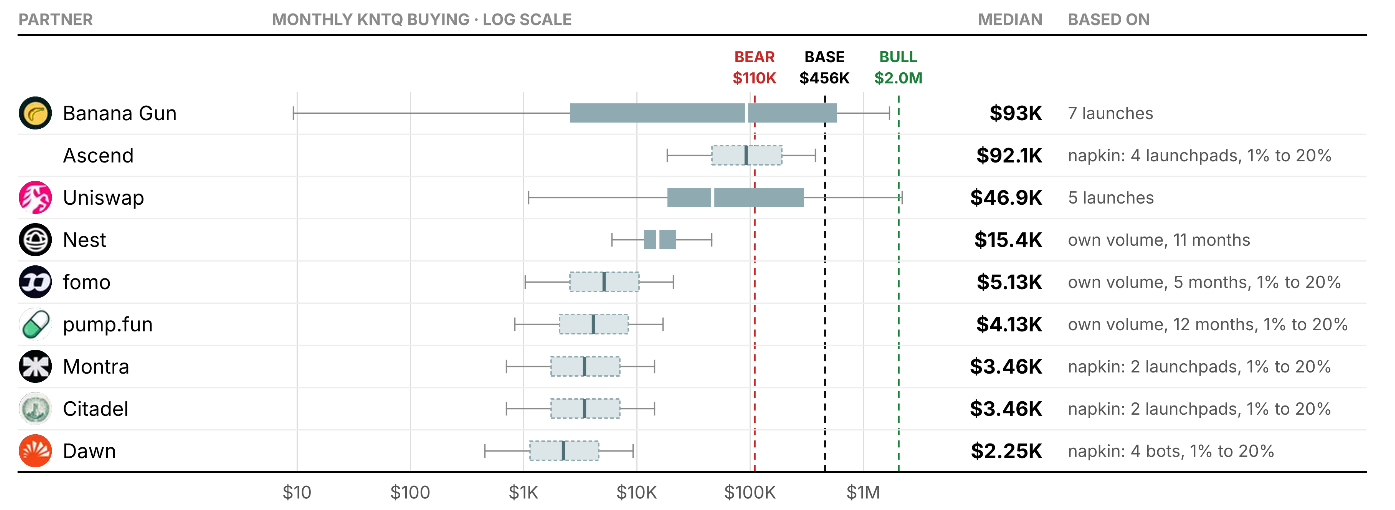
We see Robinhood Chain as Elysium's closest design comparable: an L2 built for an exchange's traders, on the same Orbit stack, that earned $47.7M in fees in its first four months. Our target needs about $750K a month of buybacks from Elysium and its partners: Blast-level sequencer fees of $456K plus about $266K of partner buying, the sum of the partner medians in Figure 5. Launch partners start that activity on day one, and at the top of our estimates, Uniswap and Banana Gun alone approach the bull case. KNTQ's order book is thin enough for buybacks to move it: a $100K market buy lifted the price 3.37% on November 6. The bear case, at the comparable median, is $0.25, down 28% from entry, and the bull case, at Robinhood Chain's level, is $2.52, up 619%. We would exit if Elysium's buybacks stay below $110K a month through March 2027.
Conclusion
Kinetiq is an asymmetric bet on Hyperliquid adoption that wins from both ends. It holds over 80% of liquid staking, moves 1.37 times HYPE, and Elysium, its L2, sends half its sequencer revenue to KNTQ. The model shows the November 27 cliff outweighs comparable-rollup buybacks on their own, so the position works if Elysium's buybacks reach the base case's $456K a month and buyers keep growing; at our $0.35 entry, the base case alone returns 88%. We will be monitoring how Elysium's sequencer revenue accrues over time and adjust our position accordingly.