陽
Yang

Financial research for on-chain institutions
We make on-chain finance legible.
Audit-grade financial reporting for DAOs and the people who allocate to them.
Audit-grade financial reporting for DAOs and the people who allocate to them.
Full-period statements, published as documents you can take away.
Accountants set the treatment. Agents apply it to the chain. The framework produces the statement.

On-chain data is novel; the principles of accounting are not. Trained accountants document how each protocol transaction should be classified, recognized, and disclosed. Those rules are then encoded as skills that agents can execute.

Equipped with those skills, agents scan the protocol contracts directly. They surface every relevant balance and transaction, categorize each entry against the standard, and aggregate the results at a specified block.

Investors cannot allocate to what they cannot see. Using agent output and protocol documentation, every Safe, reserve, and contract that rolls into the statement is mapped. The map ships with the report, so any figure can be traced back to its on-chain source.

Categorized data is evaluated for recognition, measurement, presentation, and disclosure. The output is a GAAP-style financial statement. Matzu does not provide assurance on these reports.
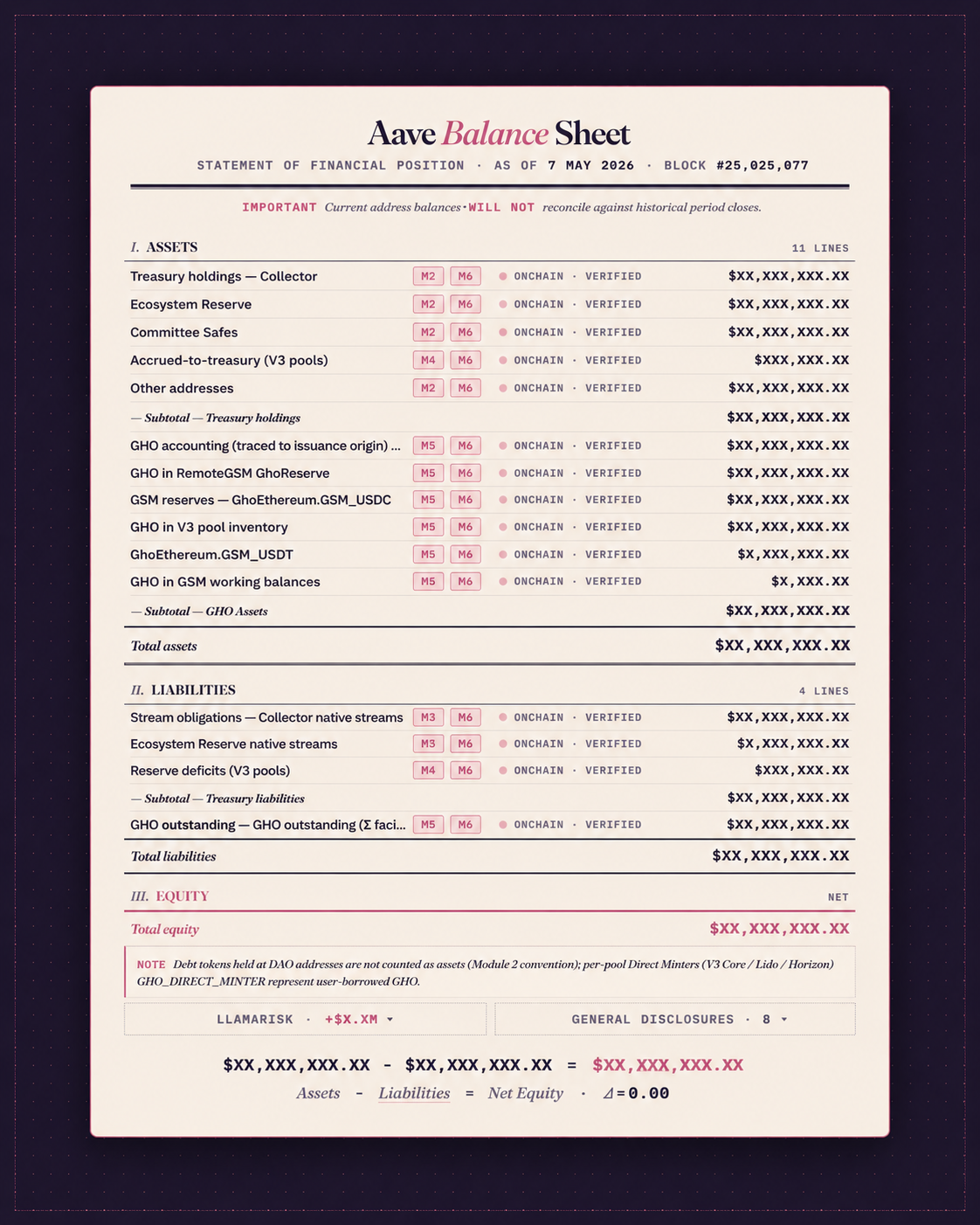
The output of the Matzu framework is a financial statement that reads like one — masthead, statement of position, sections, totals, footnotes. Familiar to anyone who has opened a 10-K, but reconstructed from chain and locked to a block.
Each line is tagged by the module that produces it (M2 for direct treasury reads, M5 for GHO-specific accounting, M6 for cross-checks). Every figure carries an Onchain · Verified marker — meaning the value can be traced back to a specific contract balance at a specific block, with no off-chain proxies or estimates.
Every Safe, reserve, and contract that rolls into the statement is mapped. The map ships with the report, so any figure can be traced back to the on-chain source that produced it — addresses, modules, and their relationships made legible.
Beyond the figures themselves, the portal surfaces governance disclosures, methodology notes, and edge-case treatments. Convention choices are cited inline. Every judgment that shapes a number is documented next to that number.
We test local Qwen variants across practical tasks and professional GDPval sectors — running on a $300 GPU, judged by Claude Sonnet 4.5.
Read the researchPractical benchmark · 31 tasks · 6 of 9 categories
Two papers published in March 2026 collapsed the estimated quantum resources needed to break Bitcoin's elliptic curve signatures by roughly 20-fold — shifting the plausible timeline for a code-breaking quantum computer from "decades away" to the early 2030s, with 25–35% of BTC supply already sitting behind exposed public keys.
80% of Fortune 500 companies now run AI agents, projected to drive $3T in transaction volume by 2030 — but the rails weren't built for machines. A map of the regulatory vacuum, the stablecoin infrastructure absorbing the gap, and how to position around it.
Blockchain lending tracks debt as math, not a balance — interest accrues through a global index that only updates on interaction. A walkthrough of an Aave Arbitrum transaction, showing how auditors can reconstruct any user's true position from public data.